What Do Insurance Companies Require Before Covering an Inflatable Rental Business?

If you’ve tried to get insurance for an inflatable rental business in the U.S., you’ve probably realized one thing quickly:
It’s not automatic.
Insurance companies don’t just look at your equipment — they look at how you run your entire operation. And if anything feels unclear, incomplete, or risky, they’ll either raise your premium or decline coverage altogether.
So what are they actually looking for?
1. Equipment That Meets Recognized Safety Standards
Before anything else, insurers want to know that your inflatables are built to accepted safety standards.
In most cases, that means:
- ASTM F2374 (design and operation standard in the U.S.)
- NFPA 701 (flame-retardant material certification)
You don’t always need a long list of documents, but you do need to show that your equipment is designed and manufactured with these standards in mind.
If you can’t provide that, many insurers won’t move forward.
This is also why having clear documentation — such as certification records and ID plates on each unit — matters more than most beginners expect. It’s often one of the first things an underwriter will ask about.
2. Clear Operating Procedures
Insurance companies are not just insuring your equipment — they’re insuring your behavior.
They want to see that you have a consistent way of operating your business, including:
- Setup procedures
- Anchoring methods
- Weather policies (especially wind limits)
- Rules for supervision
Even if it’s simple, having written procedures shows that you take safety seriously.
3. Supervision Requirements
One of the most common questions insurers ask is:
“Who is watching the inflatable during use?”
They expect:
- A responsible adult present at all times
- Someone actively monitoring the unit
- Control over how many users are inside
Unattended inflatables are a major red flag.
Even a well-built unit becomes high-risk if no one is supervising it.
4. Proper Setup and Anchoring
Insurance companies assume that setup is done correctly — but they may still ask how you handle it.
That includes:
- Using stakes or sandbags appropriate for the surface
- Securing all anchor points
- Positioning the blower safely
Improper setup is one of the most common causes of claims, so this is something they pay close attention to.
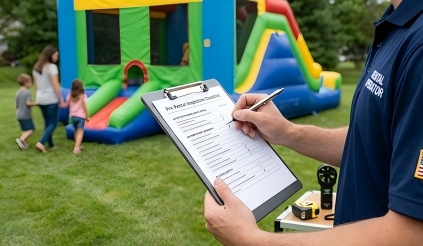
5. Inspection and Maintenance Records
You don’t need a complex system, but insurers want to know that you check your equipment regularly.
This can include:
- Visual inspections before each rental
- Checking seams, anchor points, and blowers
- Taking units out of service if something looks off
Some insurers may ask for basic maintenance logs, especially if you’re working with larger units or commercial clients.
Pro Tip: Taking a quick photo of the anchor points and the safety label at every setup is an easy way to build a simple digital record — something many insurers appreciate if questions ever come up.
6. Business Structure and Documentation
Insurance isn’t just about the equipment — it’s about your business as a whole.
You’ll typically need:
- A registered business (LLC or similar)
- A tax ID (EIN)
- Basic contact and operational information
This helps insurers assess your legitimacy and scale.
7. Experience and Claim History
If you’re new, that’s okay — but expect more questions.
If you already have experience, insurers will look at:
- Past claims
- Incident history
- Type of events you serve
Clean history = easier approval and better pricing.
8. Type of Events You Serve
Not all bookings are viewed the same.
Insurance companies will often ask:
- Do you serve private backyard parties?
- Schools or churches?
- Corporate or public events?
Larger public events usually come with higher requirements, but they also show you’re operating at a more professional level.
The Bottom Line
Insurance companies aren’t just checking boxes.
They’re trying to answer one question:
“Is this operator predictable and low-risk?”
If you can show that you:
- Use compliant equipment
- Follow consistent procedures
- Supervise properly
- Maintain your units
Then getting coverage becomes much easier.
For most operators, once these basics are in place, insurance stops being a barrier — and becomes part of running a professional, scalable business.