

What Does ASTM F2374 Actually Require for Inflatables?

If you run an inflatable rental business in the United States, you’ve probably heard of ASTM F2374.
It comes up in insurance conversations, school requirements, and sometimes even customer questions.
But most operators don’t actually read the standard itself. It’s long, technical, and not written in a way that’s easy to apply in day-to-day work.
So what does it actually require in practice?
It’s Not Just About the Product — It’s About How You Use It
One of the biggest misunderstandings is thinking ASTM F2374 is only about how inflatables are manufactured.
It’s not.
The standard focuses heavily on operation, not just design.
That means it looks at:
- How the unit is set up
- How it’s supervised
- How it’s used during an event
In other words, even a well-built inflatable can become non-compliant if it’s operated incorrectly.
Anchoring Is One of the Most Critical Requirements
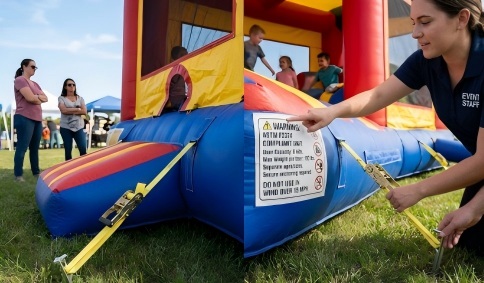
If there’s one part of the standard that comes up again and again, it’s anchoring.
Inflatables must be properly secured using stakes, sandbags, or other approved methods depending on the surface.
The goal is simple:
Prevent movement, lifting, or tipping — especially in changing weather conditions.
In real-world terms, this is often where problems happen.
Improper anchoring is one of the most common causes of accidents.
Wind Limits Are Not Optional
ASTM F2374 sets clear expectations around wind conditions.
Inflatables should not be used when wind speeds exceed safe limits, typically around 15 to 20 mph depending on the setup.
In practice, operators are expected to:
- Monitor weather conditions
- Stop use when conditions become unsafe
- Deflate the unit if necessary
Always refer to the manufacturer’s guidelines as well, since different units — especially larger slides — may have stricter limits.
Ignoring wind conditions is one of the fastest ways to create liability.
Supervision Is Required — Not Optional
The standard also emphasizes supervision.
That means having a responsible person monitoring the inflatable during use.
This includes:
- Controlling the number of users
- Separating different age or size groups
- Preventing unsafe behavior
Unattended inflatables are considered a major risk, even if everything else is set up correctly.
User Limits and Safe Operation
ASTM F2374 also covers how inflatables should be used by participants.
This includes:
- Maximum number of users
- Weight distribution
- Appropriate age group usage
Overloading a unit or mixing very different age groups can increase the risk of injury.
This is why clear rules at the entrance are so important.
ASTM F2374 also requires a permanent safety label near the entrance, showing capacity limits and basic manufacturer information.
In day-to-day operation, checking this label should be part of every setup, especially when confirming user limits before the unit goes into use.
Inspection and Maintenance Matter
The standard expects regular inspection of equipment.
This includes checking:
- Seams and stitching
- Anchoring points
- Blowers and power supply
- Overall condition of the unit
If something is worn or damaged, it should be repaired before the next use.
Documentation and Procedures
ASTM F2374 also expects operators to have basic procedures in place.
That can include:
- Setup guidelines
- Safety instructions
- Emergency procedures
You don’t need a complex manual, but you should have a clear system for how you operate safely.
The Bottom Line
ASTM F2374 is not just a manufacturing standard.
It’s a practical guide for how inflatables should be set up, monitored, and used safely.
For operators, compliance comes down to a few core habits:
- Secure anchoring
- Monitoring weather
- Active supervision
- Proper usage
- Regular inspection
Once those are in place, you’re already covering the majority of what the standard is trying to achieve.