

Who Is Responsible for Inflatable Accidents in the U.S.? (Operator, Customer & Liability Explained)

If you’re running an inflatable rental business in the U.S., this is a question you can’t avoid.
When an accident happens — whether it’s a child getting injured or equipment tipping over — people immediately ask: who is responsible?
In most cases, the operator is the first party examined, but responsibility can also involve the customer and, in rare situations, the manufacturer.
The short answer is: it depends.
In real situations, responsibility is often shared based on what actually went wrong.
The Operator Is Usually the First Point of Responsibility
In most situations, the rental operator carries primary responsibility.
That’s because the operator is responsible for:
- Delivering the equipment
- Setting it up correctly
- Anchoring it properly
- Providing basic safety instructions
If an accident happens due to poor setup, improper anchoring, or ignoring weather conditions, liability usually falls on the operator.
This is why following standards like ASTM F2374 and proper setup procedures is not optional.
The Customer (Host) Can Also Be Responsible
Responsibility doesn’t stop with the operator.
Once the inflatable is set up, the person renting it — the host — also has responsibilities.
For example:
- Allowing too many users at once
- Mixing age groups unsafely
- Using the inflatable without supervision
- Continuing use in unsafe weather
If the operator provided clear instructions and the customer ignored them, liability can shift or be shared.
Manufacturers (In Rare Cases)
Manufacturers are usually not involved in liability — unless there is a defect.
Examples include:
- Structural failure due to manufacturing flaws
- Material failure that doesn’t meet expected standards
- Missing or incorrect safety information
These cases are less common, but they do happen.
Weather Is a Major Factor
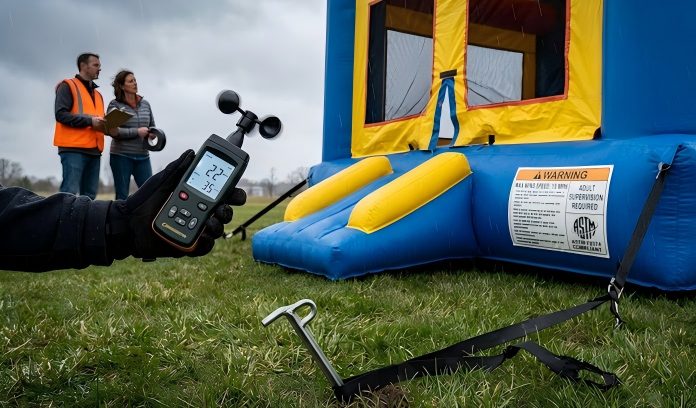
A large number of inflatable accidents in the U.S. are related to wind.
Even properly installed inflatables can become dangerous in strong gusts.
Typical safety guidance limits use around 15–20 mph wind speeds.
If an operator fails to monitor weather conditions or does not shut down in time, responsibility often falls back on them.
Why Insurance Matters
Because liability can be shared or disputed, insurance is essential.
Most professional operators carry:
- General liability insurance
- Coverage specific to inflatable or amusement devices
Without insurance, even a minor incident can become a serious financial problem.
Insurance also plays a role in determining how responsibility is handled after an accident.
What Actually Matters in Real Situations
In real-world cases, responsibility is rarely decided by a single factor.
Instead, it usually comes down to:
- Was the inflatable set up correctly?
- Was it anchored properly?
- Were safety instructions provided?
- Was the unit supervised during use?
- Were weather conditions ignored?
The more clearly these points are documented, the easier it is to determine responsibility.
The Bottom Line
In the U.S., there is no single answer to who is responsible for an inflatable accident.
Responsibility can involve:
- The operator
- The customer
- In rare cases, the manufacturer
But in practice, the operator is usually the first place liability is examined — especially when setup, anchoring, or safety procedures are involved.
That’s why proper equipment, correct installation, and clear communication are critical in this business.
FAQ
Who is legally responsible if an inflatable accident happens?
In most cases, the operator is the first party examined, especially if the issue is related to setup, anchoring, or safety procedures. However, responsibility may be shared depending on the situation.
Can the renter (customer) be held responsible?
Yes. If the customer ignores safety instructions, allows unsafe use, or fails to supervise properly, liability may be shared.
Do inflatable rental businesses need insurance in the U.S.?
Yes. Most professional operators carry liability insurance, which is often required for working with schools, events, and public venues.
What is the most common cause of inflatable accidents?
Improper anchoring and strong wind conditions are among the most common causes of inflatable-related incidents.