

How to Request Safety Test Reports the Right Way: A Pro’s Guide

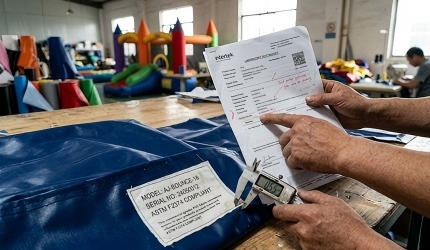
Most inflatable buyers don’t have a problem asking for safety documents. They have a problem asking the right way.
If you are importing inflatables into the U.S., your goal isn’t just to “get a certificate”—it’s to make sure the documents you receive are usable for insurance, state inspections, and long-term liability protection.
Here is how experienced buyers handle safety documentation.
1. Stop asking for “Any Certificate”
This is the most common mistake. Asking a supplier “Do you have certificates?” is too vague. You’ll likely get a generic PDF that doesn’t match your unit.
Instead, be specific. Use this exact phrasing:
“Please provide the ASTM F2374-21 compliance statement and the CPSIA lead/phthalate test report for this specific model.”
By naming the standards, you immediately show the supplier that you understand U.S. requirements.
2. Understand the Different Safety Layers
Not all documents mean the same thing. To be properly covered in the U.S., safety needs to be understood in layers.
- Structure & Design: Covered by ASTM F2374. This is the standard most insurers and inspectors look for.
- Chemical Safety: Covered by CPSIA. This ensures the material contains no harmful levels of lead or phthalates. Without it, shipments can be stopped at the port.
- Fire Retardancy: Covered by NFPA 701, which applies to the PVC material itself.
- Electrical Safety: Blowers should carry UL or ETL certification to ensure safe operation.
Each of these serves a different purpose. Missing one can create problems later.
3. Use the “3-Point Match” Test
A report is only useful if it actually matches your product. Before accepting any document, check:
- Applicant Name: The report should match the company you are paying.
- Model Name: The model number must match your unit.
- Testing Lab: Look for recognized labs such as SGS, Intertek, or TUV.
If any of these don’t line up, the document may not be accepted during inspection or insurance review.
4. Demand PDFs, Not Screenshots
Low-quality documents are a warning sign.
Avoid:
- blurred screenshots
- cropped images
- missing headers
Request full, clear PDF reports with complete pages and visible lab details.
Clean documentation usually reflects a more organized production and quality system.
5. Don’t Forget the Safety Label
Documentation doesn’t end with a PDF.
Every commercial inflatable should have a permanent safety label attached to the unit. This label connects the paperwork to the physical product.
It should include:
- manufacturer information
- a unique serial number
- maximum user capacity
Without this label, a report has limited value because there is no clear link between the document and the unit.
6. Timing Matters
Don’t wait until production is finished or the shipment is at the port.
Request sample reports before placing your order. This ensures the factory is already working to the correct standards and gives you leverage if something doesn’t match later.
Final Thought
In this industry, documentation is not just paperwork—it’s part of your risk management.
When you ask clearly, verify the details, and understand what each report covers, you avoid most of the problems that show up during inspections or insurance checks.
Reliable manufacturers treat documentation as part of the product, not an afterthought.