

How Do Factory Quality and Reseller Quality Actually Compare?

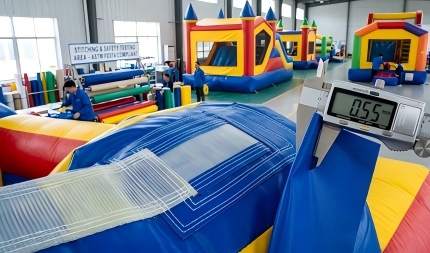
If you’ve been in the inflatable rental business for a while, you’ve probably noticed something confusing.
Two units can look almost identical in photos. Same size, same colors, same layout. But after a few months of use, the difference starts to show.
In most cases, factory-built inflatables offer more consistent quality and a longer lifespan, while reseller units tend to vary depending on their source and available stock.
That gap doesn’t come from luck. It usually comes down to who actually built the unit, and how much control they had over the process.
They’re not selling the same product
On the surface, a factory and a reseller might offer what looks like the same item:
- 15ft water slide
- commercial bounce house
- combo with slide
But they don’t start from the same place.
A factory builds from raw materials. A reseller buys finished units and sells them.
That difference affects everything that follows.
Material is where the difference starts
Most buyers focus on price first, but the real difference shows up in the material over time.
Factories that produce commercial inflatables for export to the U.S. usually use:
- 0.55mm commercial-grade PVC
- reinforced panels in high-stress areas
- stronger thread for stitching
Resellers often don’t control this part. They buy what’s available, which can mean:
- mixed material quality
- thinner vinyl in less visible areas
- less consistency from one unit to the next
You may not notice it on day one. You’ll notice it after repeated rentals.
Stitching and reinforcement decide durability
This is where two similar-looking units start to separate.
Factories that specialize in commercial inflatables typically:
- Double or reinforce seams at high-stress points
- Add extra layers and heavy-duty webbing where wear is expected
- Follow ASTM F2374 standards to ensure the unit meets U.S. safety and insurance requirements
Resellers usually can’t adjust these details because they’re not involved in production.
So even if two products look the same, the internal structure can be very different.
A simple comparison
| Aspect | Factory | Reseller |
|---|---|---|
| Material control | Full control over PVC and stitching | Depends on supplier |
| Consistency | High | Can vary |
| Customization | Flexible | Limited |
| Lead time | Longer | Faster if in stock |
| Long-term durability | More predictable | Less consistent |
Consistency is what most buyers overlook
A reseller might deliver a good unit once.
The real question is whether the next one will be the same.
Factories with stable production processes tend to provide:
- consistent dimensions
- consistent material thickness
- predictable build quality
Resellers depend on available stock, which can change depending on the source.
Customization versus stock limitation
Factories allow more flexibility.
They can:
- adjust size and layout
- match your brand colors
- add logos during production
- modify structures for your market
Resellers usually offer what is already in stock.
If you are trying to build a recognizable brand, this difference becomes more important over time.
Lead time versus control
Factories require production time.
Resellers can deliver faster if the unit is already available.
So the trade-off is simple:
- factory: more control, more consistency, longer lead time
- reseller: faster delivery, less control, more variation
Most experienced operators eventually choose based on long-term performance rather than speed.
Where the real cost shows up
The price difference is obvious at the beginning.
The real cost shows up later:
- repairs
- downtime
- lost bookings
- shorter product lifespan
A lower upfront price doesn’t always mean lower overall cost.
How experienced operators look at it
After some time in the business, most operators stop focusing on initial price.
They start asking:
- how long will this unit last under regular use
- will it hold up through peak season
- can I reorder the same quality again
That’s when the difference between factory and reseller becomes clear.
Final thought
Two inflatables can look the same when they’re new.
What matters is how they’re built and how they perform after real use.
If you’re running an inflatable rental business, you’re not just buying equipment. You’re choosing long-term reliability.