

How Do You Verify a Supplier Before Placing an Order?

If you’re planning to import inflatables, choosing the right supplier is easily the most important decision you’ll make.
Not shipping. Not pricing. Not even design.
Because once production starts, you’re committed. And if something goes wrong, fixing it later is expensive — sometimes impossible.
So the real question is: how do you know a supplier is actually reliable before you send a deposit?
Start With What They Actually Show You
Most suppliers will tell you they are “professional” or “experienced.”
That doesn’t mean much.
What matters is what they can show you — clearly and consistently.
Look for:
- Real factory photos (not just catalog images)
- Production videos showing stitching, reinforcement, or assembly
- Packing and loading footage
- Previous orders prepared for export
If everything looks like polished marketing images with no real process behind it, that’s usually a warning sign.
Ask About U.S. Standards — and See How They Respond
A reliable supplier exporting to the U.S. should be familiar with:
- ASTM F2374 (design and operation standards)
- NFPA 701 (fire-retardant material testing)
You don’t need a long technical explanation.
But you should expect clear, direct answers.
If the supplier avoids the question or gives vague replies, it usually means they don’t work with U.S. clients regularly.
Check How They Handle Details
One of the easiest ways to judge a supplier is to look at how they handle small details.
For example:
- Do they confirm dimensions clearly?
- Do they mention blower requirements without being asked?
- Do they include accessories like stakes or repair kits in their quote?
Good suppliers think ahead.
Weak suppliers wait to be asked.
Communication Tells You More Than You Think
Before you place an order, communication is your only window into how the process will go.
Pay attention to:
- Response speed
- Clarity of answers
- Willingness to explain things
If communication is slow or unclear before payment, it usually doesn’t improve after.
Verify the Production Capability
Some suppliers are factories. Others are trading companies.
Both can work, but you should know which one you’re dealing with.
Ways to check:
- Ask for workshop photos or videos
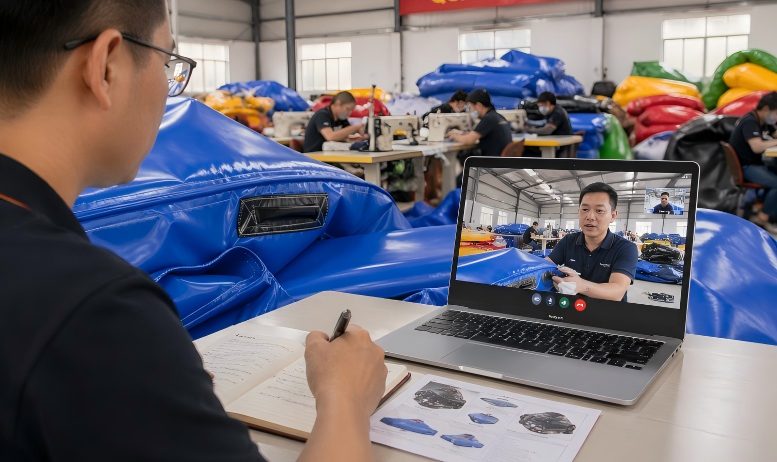
- Request a live video call from the production floor
- Look at consistency across different product photos
A recorded video can be prepared in advance, but a live video call is much harder to stage. Even a short real-time walk-through of the workshop can give you a clearer sense of whether the supplier is actually producing in-house.
A real factory should be able to show you how things are made, not just what the final product looks like.
Ask for Previous Export Experience
Suppliers who regularly export to the U.S. tend to understand:
- Packaging requirements
- Shipping documentation
- Basic compliance expectations
You can ask simple questions like:
- “Have you shipped to the U.S. before?”
- “Do you normally use DDP or FOB?”
You’re not just checking the answer — you’re checking how confidently they respond.
Look for Consistency, Not Perfection
No supplier is perfect.
But reliable ones are consistent:
- Their answers align with their photos
- Their timelines make sense
- Their pricing matches the product level
Inconsistent information is usually a bigger red flag than high prices.
Start With a Smaller Order If Possible
If you’re unsure, don’t start with a large order.
A first order is not just about buying products — it’s about testing the working relationship.
You’ll learn:
- How they communicate during production
- Whether timelines are accurate
- How they handle shipping
After one order, you’ll have a much clearer picture.
The Bottom Line
Verifying a supplier isn’t about finding someone perfect.
It’s about reducing risk before you commit.
The suppliers worth working with are the ones who:
- Show their process clearly
- Understand your market requirements
- Communicate consistently
- Handle details without being reminded
Once you find that, everything else — production, shipping, and future orders — becomes much easier.