

How Does ASTM International Shape Inflatable Safety in the U.S.?

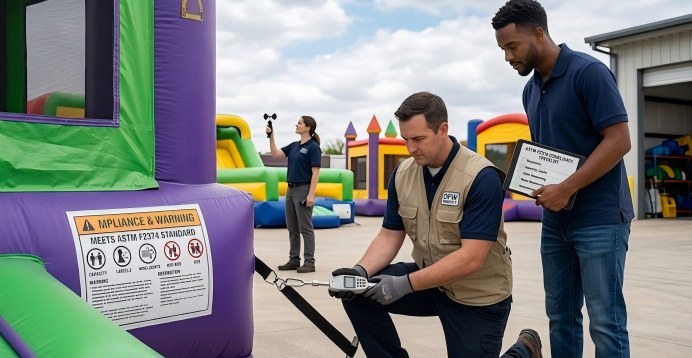
If you’ve spent any time in the inflatable rental business in the United States, you’ve probably come across the term “ASTM” more than once.
It shows up in insurance requirements, inspection checklists, and even on safety labels attached to the equipment itself.
But for many operators, ASTM still feels a bit abstract. It’s something you know you’re supposed to follow, but not something you think about day to day.
In reality, ASTM plays a much bigger role than most people realize. It quietly defines how inflatables are built, used, and approved across the U.S.
What ASTM International actually is
ASTM International is an organization that develops technical standards used across many industries.
In the inflatable world, the key standard is ASTM F2374. This standard focuses specifically on inflatable amusement devices and provides guidance on:
- Design and construction
- Anchoring systems
- Operating procedures
- Inspection and maintenance
It’s not a government law, but in practice, it often functions like one.
Why ASTM matters in real operations
You can technically run a rental business without thinking about ASTM. But the moment you step into more serious work, it becomes unavoidable.
Insurance companies rely on ASTM as a baseline. If your equipment or setup doesn’t align with ASTM F2374, you may struggle to get coverage or face higher premiums.
Event organizers also pay attention to it. Schools, churches, and corporate clients often ask for confirmation that equipment meets recognized safety standards.
So while ASTM is not enforced directly like a law, it becomes part of the system through insurance and client expectations.
How ASTM shapes the equipment itself
Most commercial inflatables used in the U.S. are designed with ASTM in mind, whether the buyer realizes it or not.
This affects details such as:
- The number and placement of anchor points
- Reinforcement at high-stress areas
- Entry and exit design
- Safety netting and visibility
Even something as simple as how a unit is staked down is influenced by ASTM guidelines.
ASTM also touches on material safety, including limits on substances like lead and certain plasticizers in the vinyl. It’s not something operators think about every day, but it plays a role in whether equipment is accepted by schools and public venues.
That’s why two inflatables that look similar on the outside can behave very differently in real use.
It’s not just about the product
ASTM doesn’t only apply to how inflatables are made. It also covers how they are operated.
This includes:
- Wind limitations
- Supervision requirements
- Setup procedures
- Daily inspection practices
For example, many operators think of 15–20 mph as the standard wind limit. In practice, ASTM F2374 emphasizes following the manufacturer’s specific guidance, which can vary depending on the design of the unit. Higher-quality equipment often comes with clearer wind recommendations and monitoring practices, while lower-end units tend to leave more room for guesswork.
In other words, compliance isn’t just about what you buy—it’s about how you run your business.
Where most operators misunderstand ASTM
One common mistake is thinking that ASTM is a certificate you either have or don’t have.
In reality, it’s a framework.
A manufacturer may say their units are built “according to ASTM,” but that still needs to be supported by proper design, documentation, and labeling.
That’s why experienced operators don’t just ask for a statement. They look for:
- Clear safety labels on the unit
- Defined capacity limits
- Consistent documentation
- Practical setup guidance
These are the things inspectors and insurers actually look at.
How ASTM connects to inspections and liability
In many states, inflatable devices are subject to inspection requirements.
Inspectors often use ASTM standards as a reference point when evaluating:
- Structural integrity
- Anchoring
- Safety signage
- Overall setup
If something goes wrong, ASTM can also become part of the conversation around liability.
It helps establish what is considered “reasonable” or “expected” practice in the industry.
The bottom line
ASTM doesn’t sit on the surface of the inflatable business. It sits underneath it.
You may not think about it during a typical weekend setup, but it influences:
- What equipment you buy
- How you install it
- What clients expect
- How insurers evaluate your risk
Understanding ASTM isn’t about memorizing rules. It’s about recognizing the standard that the entire industry quietly operates on.
And once you see that, a lot of decisions—especially around equipment and operations—start to make more sense.