

Is the LA Bounce House Market Saturated? The Surprising Truth for 2026?

If you’ve been looking at the inflatable rental business in Los Angeles, you’ve probably heard two completely different opinions.
Some people say the market is saturated and not worth entering. Others seem to be fully booked every weekend and expanding their inventory every season.
So which one is true?
The honest answer is this: the market is still growing, but it’s not growing in a way that benefits everyone equally.
The demand hasn’t gone anywhere
Los Angeles is one of the few cities where this business can run almost year-round. There’s no real “off season” compared to colder states. Birthday parties, school events, church gatherings, and backyard celebrations happen every week.
Even during slower months, there are still bookings coming in. The demand is stable, and in many areas, it’s actually increasing as more families prefer hosting events at home instead of renting venues.
On top of that, Los Angeles is preparing for major international events in 2026, including the World Cup. That kind of exposure tends to push demand even higher, especially for larger setups like obstacle courses and interactive games used in commercial or corporate events.
From a pure demand perspective, this is still a healthy market.
The difference is in what people are renting
What has changed over the past few years is not demand, but what customers are willing to pay for.
Basic bounce houses are everywhere. You can find them on Facebook Marketplace at very low prices, and many new operators start there because the entry cost is low.
The problem is that customers in Los Angeles have seen everything already. A standard jumper doesn’t stand out anymore, especially in a competitive neighborhood.
What continues to book well are:
- Water slides, especially during warmer months
- Larger combo units that keep kids engaged longer
- Obstacle courses for bigger groups and events
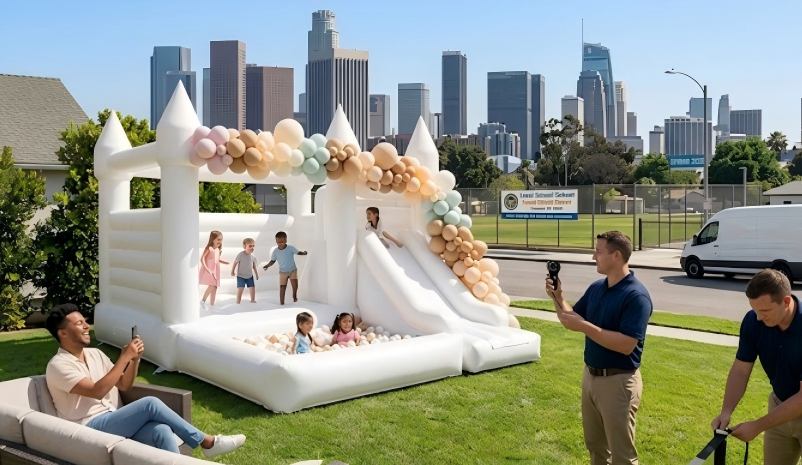
There’s also a noticeable shift in design preferences. In areas like Santa Monica or Silver Lake, people care about how things look just as much as how they function. Cleaner color schemes and more modern designs tend to perform better than the traditional bright primary-colored castles.
Competition is real, but not evenly distributed
It’s true that Los Angeles has a lot of rental companies. But they are not all competing on the same level.
There are operators who take every job across the city, spend hours driving, and compete mainly on price. These businesses tend to struggle with margins.
Then there are operators who stay local, build a strong presence in specific neighborhoods, and focus on higher-value bookings. They are not necessarily working more—they’re working smarter.
In practice, you’ll often see one company fully booked in a small area while another is barely getting calls in the same city.
The market favors operators who treat it like a business
This is probably the biggest shift.
A few years ago, it was possible to treat inflatable rentals as a simple side hustle. Post a few listings, answer messages, and pick up some weekend jobs.
That approach doesn’t work as well anymore in Los Angeles.
Customers expect:
- Clear pricing
- Reliable communication
- Clean, professional equipment
- On-time delivery and setup
Pro Tip: In LA’s traffic, route density is everything. Operators who limit their delivery zones and group bookings geographically tend to make significantly more per day than those driving across the entire city.
So, is the market still growing?
Yes, it is.
But it’s not the kind of growth where anyone can enter and make money right away.
It’s a market that rewards:
- Better equipment choices
- Smarter service areas
- More professional operations
If you approach it that way, there is still plenty of room to grow. If not, it can feel like the market is already full.
The bottom line
Los Angeles isn’t short on demand. It’s short on well-run rental businesses.
That’s why some operators are fully booked every weekend, while others are still waiting for their next call.
The opportunity is still there. The difference is in how you approach it.