

What Documents Should a Reliable Manufacturer Provide?

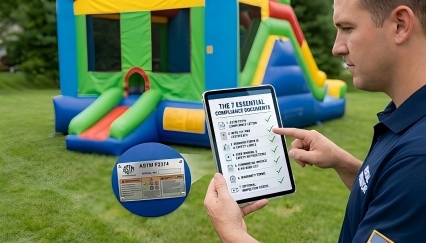
If you’re buying commercial inflatables for the first time, it’s easy to focus on price, design, or delivery time.
But experienced buyers look at something else first:
Documentation.
Because at some point, whether it’s insurance, a school event, or a local inspection, someone is going to ask:
“Can you prove this equipment is compliant and safe?”
And when that moment comes, the difference between a reliable manufacturer and a risky one becomes very clear.
1. Safety Standard References (ASTM F2374)
In the U.S., inflatable amusement devices are expected to follow ASTM F2374.
A reliable manufacturer should be able to confirm that their designs and production follow this standard.
In practice, insurers often look for an ASTM F2374 compliance statement. If a manufacturer cannot provide clear confirmation, it may affect your ability to obtain or maintain liability coverage.
This doesn’t always come as a single certificate, but they should be able to provide:
- A compliance statement or declaration
- Design references aligned with U.S. requirements
- Clear usage and anchoring guidelines
If a supplier avoids this topic or gives vague answers, that’s usually a warning sign.
2. Fire Retardancy Certification (NFPA 701)
Flame-retardant material is not optional in many use cases.
If you plan to work with:
- Schools
- Indoor venues
- Public events
You will likely be asked for NFPA 701 certification.
A reliable manufacturer should provide:
- Test reports for the PVC material
- Clear confirmation of flame-retardant properties
Without this, many venues simply won’t allow the equipment to be used.
3. Manufacturer Identification and Safety Labels
Every commercial inflatable should include a permanent label.
This typically shows:
- Manufacturer name
- Serial number
- Production date
- Capacity limits
This is not just for formality.
It is about traceability. In the rare case of a recall or a safety alert, that serial number is what helps identify the unit and protects your business from unnecessary liability.
Inspectors and insurance providers often look for this first.
If the unit has no identification plate, it immediately raises concerns about traceability.
4. User Manual and Safety Instructions
A proper manufacturer should provide basic documentation on how to operate the unit safely.
This may include:
- Setup instructions
- Anchoring guidelines
- Wind limitations
- Supervision recommendations
You may not read it every time, but having it available matters when questions come up.
5. Packing List and Commercial Invoice
For international buyers, shipping documents are part of the process.
At minimum, you should receive:
- Commercial invoice
- Packing list
- Product description with values
These are required for customs clearance and should match the actual shipment.
Pro Tip: Make sure the values listed on the invoice are consistent with your payment records. Mismatches can slow down customs clearance in the U.S. and create unnecessary delays.
6. Warranty Terms
A reliable supplier should clearly state what they stand behind.
This usually includes:
- Warranty period
- Coverage scope such as seams and stitching
- Basic after-sales support
If warranty terms are unclear or constantly changing, that’s something to take seriously.
7. Optional but Valuable: Inspection or Test Videos
While not a formal document, this is something experienced buyers always ask for.
A short video showing:
- The unit fully inflated
- Air pressure stability
- Overall condition
This gives you a real-world view before shipping.
If a supplier hesitates to provide this, it’s worth asking why.
The Bottom Line
Documents are not just paperwork.
They are proof that your equipment can be:
- Insured
- Approved
- Safely operated
A reliable manufacturer understands this and is prepared to provide these details without hesitation.
If you have to chase basic documentation, it’s usually a sign that problems may show up later in the process.